


- Diameter:
- mm From 800mm to 2400mm (double unit option available)
- Ring stiffness:
- from SN2 to SN16
- Productivity:
- from 1l/s
- pressure:
- from 3 m. w.s.
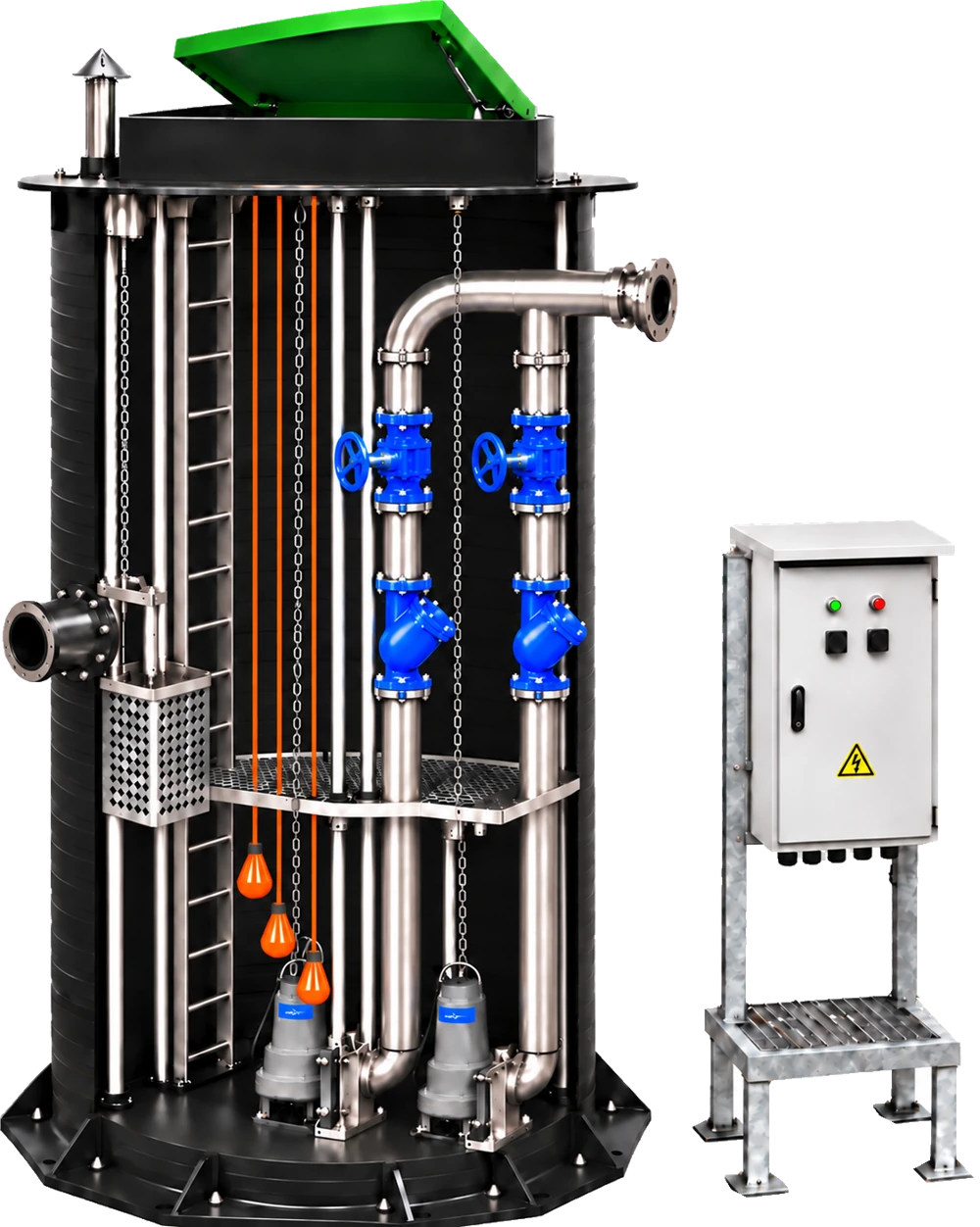
Sewage pumping station BioTop Pump Station is designed for pumping household, rain and industrial wastewater from separate buildings, facilities, towns and cities. The station can be used both as a stand-alone facility and as part of a treatment plant complex. The design of the BioTop Pump Station casing can be manufactured to any requirements of the customer and regulatory organizations, the station can be equipped with automated screens, crushers, isolation valves with electric drives, as well as the required number of pumping units. To accommodate the necessary equipment, the station casing based on the SWP pipe can be made both as a separate vertical tank with a diameter of up to 3600 mm, and in a double and triple case with the necessary dry zones, service platforms and technical pavilions. The BioTop Pump Station sewage pumping station can also be made in a horizontal casing for use as part of rainwater treatment plants for accumulating and pumping the daily volume of water, as well as part of peak water flow equalizers in domestic and industrial wastewater treatment plants. BioTop Pump Station is equipped with the necessary piping, isolation valves, stairs, service platform and pipe coupling systems for installing pumping units, various sensors, automatic control systems, sediment agitation systems, etc.
Types of pumping station casings
Vertical installation
Horizontal installation
According to the type of pumping equipment installation, sewer pumping stations are divided into:
Pumping stations equipped with submersible pumps
Pumping stations equipped with a separate intake chamber with overlap
Pumping stations equipped with a separate receiving tank and dry pumps
Multi-case stations
Sewage pumping stations, depending on the type of pumped wastewater, are divided into:
BioTop Pump Station (sewage pumping station) for pumping household wastewater, as well as industrial wastewater close to them in composition;
BioTop Pump Station for pumping groundwater;
BioTop Pump Station for pumping rainwater.
Depending on the purpose of BioTop Pump Station, the station is filled with technological equipment. For BioTop Pump Station domestic sewage, due to the large number of fibrous inclusions, pumps with open impellers, wheels with a cutting edge are characteristic. It is undesirable to use valves with rubber-coated locking parts in isolation valves. Pumping stations for storm and drainage sewers are characterized by open-wheel pumps. Isolation valves can be with rubberized locking elements.
Any design and construction company can contact our constructor department to receive robustness calculations of loads, calculations of the plate against ascent, selection of pumping equipment and many other technical services.
Sewage pumping station: selection and operation
Polyethylene pumping station made for the project
BioTop designs and manufactures sewage pumping stations in Georgia for private houses, buildings and industrial sites where wastewater cannot reach a sewer or treatment plant by gravity. The tank, pumps, pipework and controls are selected as one system for the required flow and total head. The station transfers wastewater; treatment is performed separately. BioTop manufacturing in Georgia · English product catalogue.
Pump selection by flow Q and total head H
Flow Q is the volume to be pumped per unit of time; the design must account for the normal inflow and peak inflow. Total head H includes the elevation difference and hydraulic losses in the pressure pipe, bends and valves. Any required pressure at the receiving connection must also be accounted for. The duty point must lie within the permitted operating range on the selected pump's performance curve.
For selection, specify the pressure-pipe length and internal diameter, the receiving level, wastewater temperature and the nature of solids. Motor power alone, or the maximum flow and maximum head quoted separately, does not determine a suitable sewage pump.
Pumps, pipework and backup
The number of duty and standby pumps is determined by the required reliability, flow and operating conditions. Where provided by the design, duty alternation helps distribute running hours, while another pump can start when inflow increases. The free passage, impeller type and materials must suit the wastewater.
The equipment package may include guide rails and pump couplings, non-return valves, isolation valves, a screening basket and service-access equipment. The illustration shows a possible arrangement; the final supplied components are listed in the project and quotation.
Controls and high-level alarm
Level sensors signal the control panel to start and stop the pumps. The design defines operating levels, a high-level alarm, motor protection and permitted start frequency. Remote monitoring and backup power are included only when specified in the equipment package.
Installation, ventilation and service access
The inlet elevation, tank location, groundwater conditions, base and anchoring are determined during design. Provide the required ventilation and safe access for pump removal and maintenance. Installation and commissioning must follow the project and the selected equipment manufacturer's instructions.
Operation and maintenance
Check the pumps, level sensors, alarm, valves and ventilation, and remove accumulated debris in accordance with the operating instructions and actual loading. Wipes, construction waste and other unsuitable solids must not enter the sewer. Unusual noise, vibration, repeated starts or a high-level alarm require investigation.
Before maintenance, isolate the electrical supply and prevent unintended restart. Use the designated lifting equipment. Work involving an underground wastewater tank must be carried out by qualified personnel under appropriate safety procedures.
What determines the price of a sewage pumping station?
The quotation depends on the required flow and head, the tank dimensions and installation depth, the number and type of pumps, the controls, the pressure connections and the installation scope. Send the project inputs for a calculation; there is no single standard price for every site. Send the design flow Q, total head H and wastewater characteristics. If these values are not yet known, provide the site levels, pipe length and diameter, and the purpose of the facility. The quotation identifies the tank, pump configuration, pipework and controls included in the supply.

