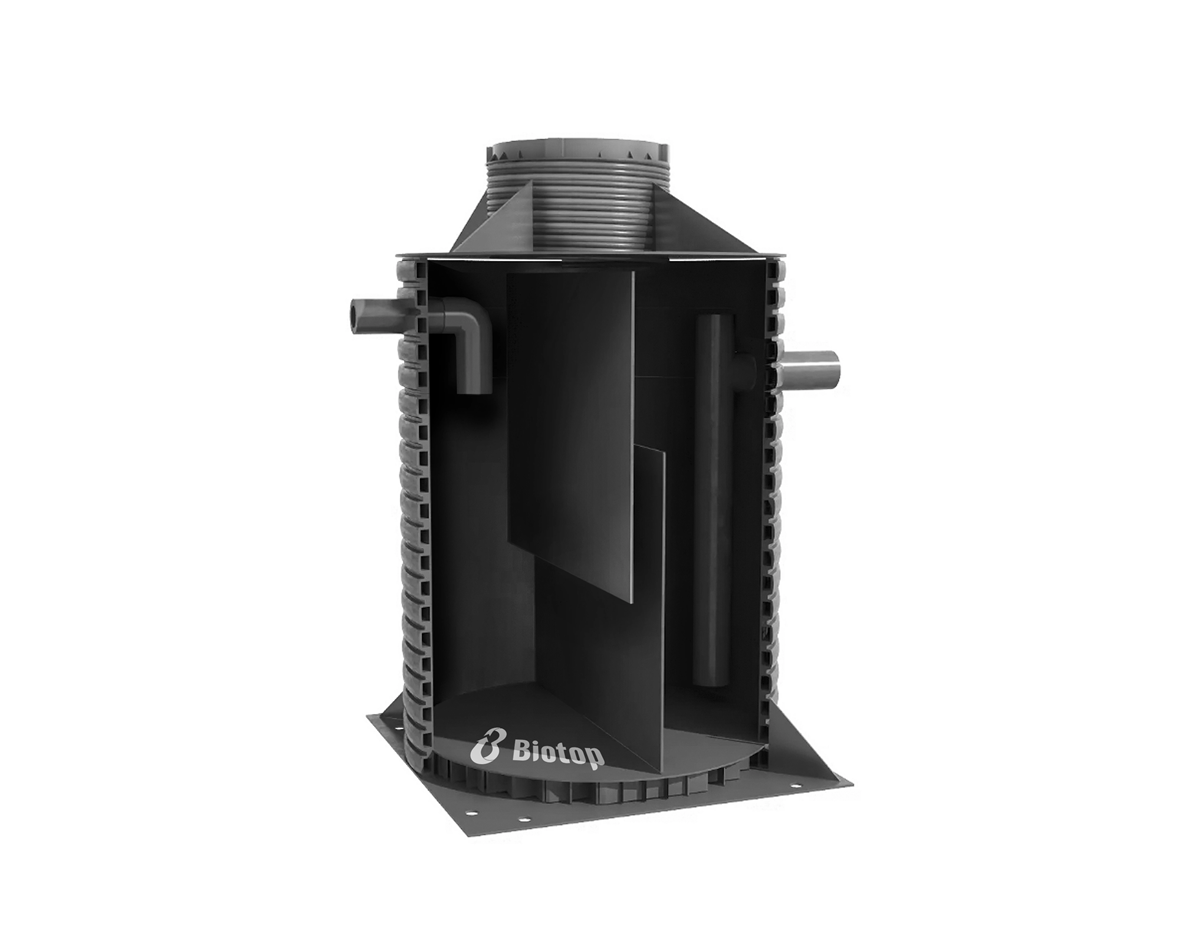
BioTop GS — industrial grease traps designed to separate free vegetable and animal fats from wastewater generated by large commercial kitchens, restaurant complexes, and food processing facilities. The catalog features the GS V1.5, V3, V5, V7, and V10 models.
What Is an Industrial Grease Trap?
This is a pre-treatment tank in which free fat is separated based on the difference in density between water and the fat phase. Accumulated contaminants remain inside until they are removed during maintenance. The industrial model is selected based on the corresponding design flow rate and installation conditions.
The grease trap is not designed to remove petroleum products, solvents, or stable chemical emulsions. Toilet wastewater and rainwater should not be directed into the kitchen grease trap. For complex industrial wastewater, the system configuration is determined on a case-by-case basis.
Selecting BioTop GS and Installation Requirements
To perform the calculation, you will need the peak flow rate, a list of equipment, operating conditions, temperature, and the nature of the contaminants. The capacity and dimensions of each model are listed in its product sheet. The model number should not be used as a substitute for checking the technical specifications.
When selecting a location, consider the inlet and outlet elevations, the ventilation specified in the design, soil conditions, and access for service equipment. Underground installation, housing protection, and measures for high groundwater levels are carried out in accordance with the design and installation instructions. A large restaurant may also require a BioTop GS.
Operation of an Industrial Grease Trap
Monitor the buildup of grease and sediment, and keep a maintenance log. Determine the frequency of waste removal based on actual usage, the unit’s capacity, and the manufacturer’s instructions; infrequent cleaning reduces the usable volume and can cause clogs and odors.
Maintenance includes removing the oil phase and sediment, cleaning the internal surfaces, and inspecting the pipes, covers, and seals. Before resuming operation, fill the tank with clean water to the operating level as specified in the instructions. Dispose of waste properly.
Chemical agents and biological additives are no substitute for removing accumulated fat. Maintenance of underground tanks must be entrusted to trained specialists; entering the tanks without the safety measures specified in the design is prohibited.